houtkachel tent Nomad Large Wood Stove
SKU: 17125788616
houtkachel tent

houtkachel tent Nomad Large Wood Stove

Sale price$26.15 Regular price$29.06
Save 10%

Pay in installments of $7.26 with ShopPay, AfterPay and Klarna

Shipping Estimate
USA
  • USA
  • CAN

Ships within 48 hours · Estimated delivery Jun 29 - Jul 4

Promo Codes Available:

For Your Every Summer RSVP, with Code: SUMMER15

Description

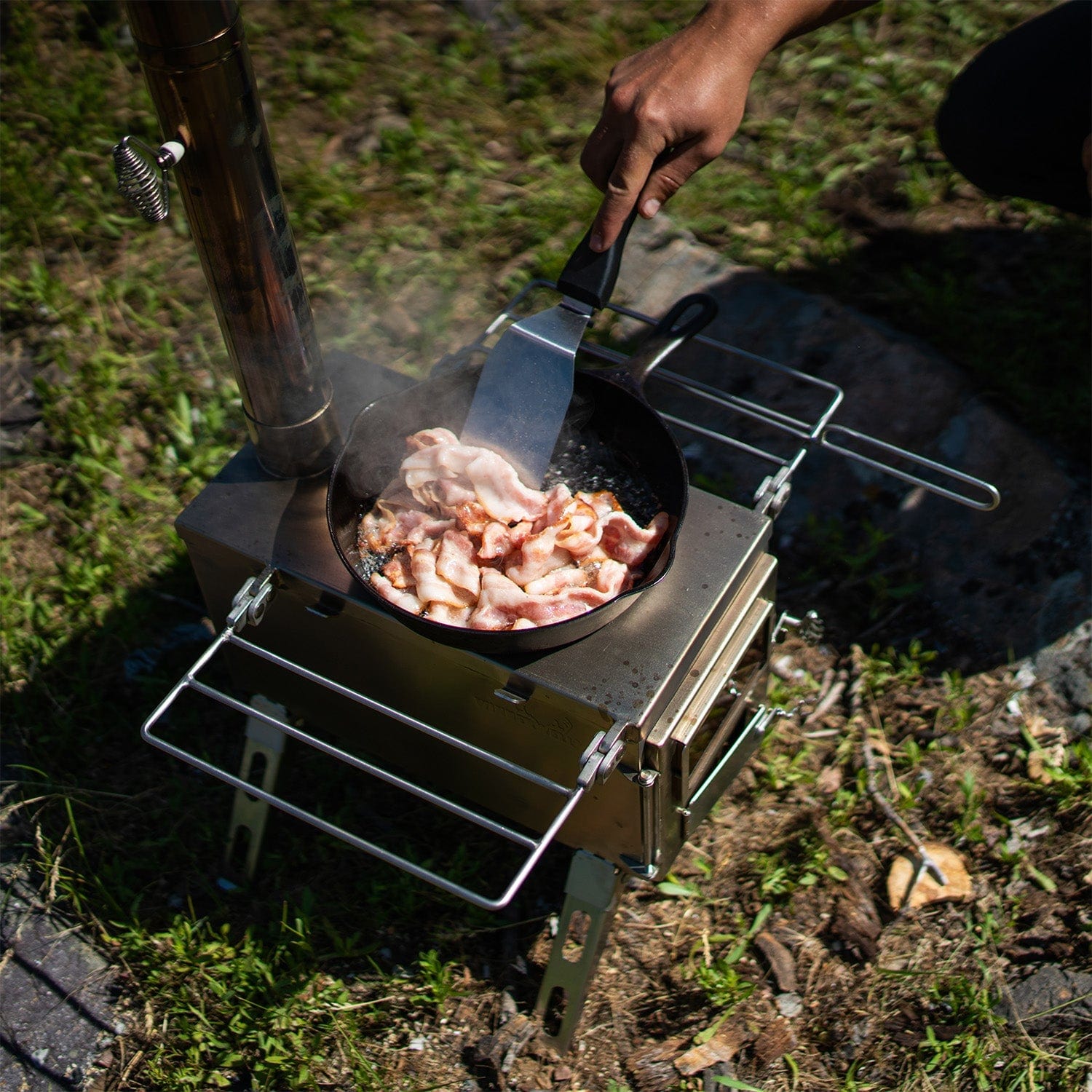
houtkachel tent Nomad Large Wood StoveThe Winnerwell Nomad Large Stove, an upscale model of our best selling Nomad Stove, stands out with its rectangular firebox and large door window. Crafted with top notch 304 stainless steel, this stove deploys swiftly to heat small spaces, making it a remarkable heating and cooking solution for canvas tents and other recreational shelters. The 4 leg design provides a compact footprint, making the Nomad an optimal choice for small spaces, especially

The Winnerwell Nomad Large Stove, an upscale model of our best-selling Nomad Stove, stands out with its rectangular firebox and large door window. Crafted with top-notch 304 stainless steel, this stove deploys swiftly to heat small spaces, making it a remarkable heating and cooking solution for canvas tents and other recreational shelters. The 4-leg design provides a compact footprint, making the Nomad an optimal choice for small spaces, especially when combined with a fireproof hearth area to minimize clearance requirements.

Crafted with corrosion-resistant 304 stainless steel, it comes with an 1/8” thick cooktop and a 1/16” thick body. The package includes the stove body, an airflow controller pipe, four sections of straight chimney pipe (3.5” diameter, 17” length), a spark arrestor, and an ash scraper. Weighing 34 pounds, the Nomad has packed dimensions of 18” x 9.8” x 9.8” and assembled dimensions of 20” x 25” x 108”.

The firebox has a capacity of approximately 1500 cubic inches, perfect for seasoned, dry wood. The door is equipped with an air-control damper and a glass window for efficient fire management and ambiance. The stove also features level side shelves for cooking versatility which double as a carry handle. Nesting legs and shelves fold flat to the stove body, making it highly portable. The Nomad is compatible with large size and 3.5” Winnerwell Stove accessories.


Details
  • Precision-crafted in 304 Stainless Steel that is highly resistant to rust and corrosion (1/8” thick cooktop material, 1/16” thick body material)
  • Includes 1 stove body, 1 airflow controller pipe, 4 sections of straight chimney pipe (3.5” diameter, 17” length), 1 spark arrestor, and 1 ash scraper
  • Weight: 34 pounds
  • Packed Dimensions/Stove Body Dimensions: 18” x 9.8” x 9.8”
  • Assemble Dimensions: 20” x 25” x 108” (108” indicates total height from the ground to the spark arrestor)
  • Footprint Dimensions: 20” x 18”
  • Firebox Capacity: Approx. 1500 cubic inches (18” stove body depth nicely accommodates split wood)
  • Fuel Type: dry, seasoned wood only (not intended for coal burning)
  • Door features an air-control damper and a glass window for fire management and ambiance
  • Level side shelves lend cooking versatility and double as a carry handle
  • Highly portable- Nesting legs and shelves fold flat to the stove body; 5 pipe sections, spark arrestor, and an ash scraper stow inside the stove body
  • Wide 4-leg design helps keep the stove stable on uneven surfaces
  • Compatible with Large Size and 3.5” Winnerwell Stove Accessories
  • Certifications: N/A (This is a recreational wood burning stove not intended for residential use)
Accessory Recommendations

For added cooking utility, we recommend the Large Water Tank and the 3.5” Pipe Oven. The water tank is excellent for melting snow and ice for drinking water, and when the stove is burning efficiently the tank will boil water in minutes thanks to its location at the back of the cooktop and the base of the flue pipe where heat is concentrated. The 3.5” Pipe Oven is large enough to cook biscuits, cookies, baked potatoes, and more. Using a large skillet or dutch oven on the cooktop in conjunction with the Pipe Oven provides a very functional camp kitchen set up.

Installation Recommendations

When utilizing a wood stove in a tent or shelter, it is of utmost importance to prioritize safety by maintaining adequate clearances. We strongly advise keeping a minimum distance of 18 inches between the stove and any combustible materials. However, if you employ a non-combustible heat shield or fireproof hearth, these clearances can be reduced by half.

To ensure safe installation, we highly recommend the use of a Double Wall Pipe Section and a Flashing Kit where the flue exits the tent or shelter. It is crucial to have a fireproof stove jack for the flue to pass through, and always make sure that combustible materials are kept clear of the stove or flue.

In situations where the shelter may experience movement, such as in a trailer or boat, it is particularly critical to secure the stove legs using tent stakes, bolts, or other adequate anchors. This precautionary measure helps prevent the stove from tipping over and causing potential accidents or damage.

By adhering to these safety guidelines, you can minimize the risk of fire hazards and ensure a secure environment while using a wood stove in your tent or shelter. Remember, safety should always be the top priority when operating heating appliances in confined spaces.

Operating Tips

Mastering the art of operating a wood stove is like learning to salsa dance - it takes some patience, practice, and a little bit of heat. Kick-start your fire with a hot bed of coals, as this boosts the air draw through the stove and up the flue. Begin your fiery masterpiece with a generous pile of small tinder, then gradually introduce larger wood pieces. Remember, when opening the door, do it slowly to keep the smoke inside the stove and out of your cozy shelter.

Starting your fire with flammable accelerates like lighter fluid is a big no-no. Practice makes perfect, so we strongly suggest you test drive your stove outdoors for the first few burns. This way, you'll be able to finesse your fire-starting skills and learn how to use the airflow controls to get the perfect burn temperature and rate.

An efficient stove is like a stealthy ninja, burning hot enough to use the fuel effectively and producing little to no visible smoke. If your chimney is puffing out thick smoke like a steam train, your stove isn't burning efficiently. Don't overload the stove with fuel, either – too much heat can warp or damage your trusty stove. So, take it slow, and you'll be a wood stove whiz in no time!

Warning & Considerations

Never leave a wood stove burning unattended. The surface of Winnerwell Wood Stoves become extremely hot during use, always wear leather gloves and exercise caution when operating the wood stove. Careful supervision of children and pets is mandatory when operating the wood stove to prevent harm or injury. When children or pets are present, we strongly recommend the use of fence panels or a stove guard to prevent unintentional contact with the stove. Only burn clean, dry, seasoned firewood in Winnerwell Wood Stoves. Burning green wood can result in carbon monoxide which is hazardous to health as well as increase the build up of creosote in the flue pipe which can create the risk of chimney fire. Clean the flue regularly (approx. every 20 hours of burn time) to avoid excessive creosote build up which can inhibit airflow and create the risk of chimney fire. We recommend a Winnerwell Pipe Brush for cleaning the flue. User assumes responsibility for the safe use of this wood stove.

Shipping Notes
  • Free Standard Shipping on $100+ Orders to the USA.
  • Except Preorder products are shipped in 48 hours.
  • Delivery to the USA:
  1. Standard Shipping : 3-10 business days
  • If time is of the essence, please consider selecting expedited delivery for faster service.
Exchange/Return Notes
  • We offer a 30-day return/exchange service after receiving.
  • Final sale items are not eligible for returns or exchanges.
  • To process your return/exchange, please contact us at [email protected]
  • Please click here for more details>>> Return & Exchange Policy
SKU: 17125788616

Discover Niche Categories That Outsell houtkachel tent

Top-Converting Item to Boost Your Average Order

4.4 ★★★★★
Based on 2342 reviews
Sort
Highest Rating
Newest First
Oldest First
Product Reviews
J
Verified Purchase
John D. Cofield
Dallas, US
★★★★★ 5
Consequence After Consequence
Format: Hardcover
"In Fourteen Hundred Ninety Two, Columbus Sailed The Deep Blue Sea" is a ditty sung by generations of school children. Most of those students learned and believed that Columbus was the only man in Europe who believed the world was round and proved it by sailing three ships west to find the East. In 1493, Charles C. Mann dismisses these legends and goes on to demonstrate that Columbus (or as he refers to him, Colon) and the other Europeans who sailed across the Atlantic in the 1400s and 1500s did far more than just discover a New World, they helped create a planet wide system in which people, plants, animals, and diseases travelled further and were linked in more ways than had ever before been possible. In other words, 1493 was the beginning point of a new age of globalization. This is not a new theory. Alfred W. Crosby developed the term Columbian Exchange back in the 1970s to describe the changes that took place after 1492. Jared Diamond's Guns, Germs, and Steel and Collapse also detailed some of the consequences of the European "discovery" of the Americas. What makes Mann's new book so appealing is his ability to tell an engrossing story that ably explains how one consequence led to another, fundamentally changing society after society and helping to creat our modern world. This is global history at its best, jumping from Ming and Qing China's opulent but troubled societies to the fast growing but still relatively backwards European states to the myriad African and Native American cultures, all of them to be affected by the transfer of peoples, plants, diseases, and ideas. Mann has a keen eye for an appealing and informative anecdote which really details the consequences of seemingly small decisions, such as how the introduction of the sweet potato to China led to deforestation, or how the Little Ice Age was affected by the abandonment of the Native American practice of burning off underbrush in North American forests. Its books like 1493, as well as Mann's earlier and equally excellent 1491, which make studying history so fascinating. I taught Advanced Placement World History to high school students for many years before retiring, and I regularly amused them (at least I hope I did) with many references to Jared Diamond and Alfred Crosby's ideas. With 1493 Charles C. Mann deserves equal recognition by global historians.
WAS THIS REVIEW HELPFUL?YesReportShare
Reviewed in the United States on August 19, 2011
V
Verified Purchase
Victor Vögel
Bozeman, US
★★★★★ 5
Mesmerizing; shows the butterfly effect in action
Format: Paperback
Charles Mann’s “1493” is about globalization and the Homogenocene epoch. Unlike the plenitude of other recent books about globalization, however, “1493” is about biological globalization rather than economic globalization. The book traces the results of the Columbian Exchange, with chapters devoted to tobacco, the earthworm, malaria, silver, potatoes and sweet potatoes, guano and rubber. The book is in four parts, and is written in an accessible, non-academic style. I found the first three parts of the book, which cover the impact of the Columbian Exchange on the Atlantic, the Pacific and Europe, respectively, to be captivating. These parts of the book demonstrated the fascinating interconnectedness of all things in a globalized society (in other words the “butterfly effect”) – for example, how transporting the sweet potato to Western China led to population migrations from Eastern to Western China, deforestation and overflowing of the Yellow River. The general result of such biological globalization is the creation of the Homogenocene epoch, a term which Mann uses to describe the biological homogenization that has replaced biological diversity since the time of Columbus. In the first three parts of the book, Mann demonstrates how history, biology and chemistry are all interrelated, and how today’s world continues to be influenced by the Columbian Exchange. I found the last part of the book to be less impressive than the first three parts. Part Four is called “Africa in the World,” but confusingly it is about South America, not Africa. Parts of it read more like travel writing than history. Still, the book deserves five stars for the first three thrilling parts, which successfully trace the mesmerizing history of various everyday biological substances.
WAS THIS REVIEW HELPFUL?YesReportShare
Reviewed in the United States on December 31, 2017
J
Verified Purchase
Jamie Barnett
Massapequa, US
★★★★★ 3
There were periods I was on the edge of my seat. There were times I just wanted to the book to end.
Format: Paperback
I recently started reading at 40 years old to make up for a lot of wasted time and missed education. This is a very informative read, but that said, I had a hard time staying focused sometimes. He gets into a lot of the science pertaining to plagues, epidemics etc which is interesting and I am reluctant to list science as a con as I did learn, but frequently found myself scrolling through several pages just to get the main idea behind the historical part. There were periods that I was on the edge of my seat and there were times I just wanted to the book to end. 1491 was similar. Both useful books, but a bit challenging to follow along especially if you are only reading small amounts at at time like on break at work etc. It jumps around from S. America, N America and China all through the book. I would have preferred that each region be separated. I get that he had his reasons. I am glad I read both books, but I probably should have gone with more of an overview vs the more in-depth content in this. I do not regret reading both books however, and recommend if you already have a good knowledge of this subject and are just trying to learn a little more. I found the information about the slave trade, the most interesting and wasn't aware that the majority of slaves shipped over from Africa went to Mesoamerica and the Caribbean. I also did not realize that plague and sickness really enabled use of African slaves as they were not prone to malaria like the Europeans. There is also some good info about ancient China and also sliver and mercury mining with South American Indians which made the book worth it for me.
WAS THIS REVIEW HELPFUL?YesReportShare
Reviewed in the United States on March 7, 2023
R
Verified Purchase
R. D. Morris
Natrona Heights, US
★★★★★ 4
If you liked 1491, you'll like 1493
Format: Hardcover
I originally read the first edition of 1491, which I loved. So that's why I ordered 1493. At about the same time 1493 arrived, I found out there was a new, revised version of 1491, which my husband bought from another source. So I re-read it at the same time I read 1493 for the first time. The reason I mention this is that there are some similarities between the revised version of 1491 and the newer book, 1493 - actually some repeated material. That's ok, as the author is taking the premise of 1491 another step further. Essentially, 1491 focuses on what new studies show was really going on in the Western Hemisphere before Columbus' arrival, where native peoples were far more numerous and had more advanced cultures than Europeans previously thought possible. In 1493, Charles Mann shows not only how Columbus and Europeans changed the New World, but how the "Columbian exchange" wrought great changes in the other direction as well. And he pulls in the further exchanges with Asia, to show the trans-global linkages of the phenomenon. So, some of his exposition gets a little repetitious, but overall he's an engaging writer, and for those of us who love the history of cultural exchanges and first contact, these books are mandatory reading!
WAS THIS REVIEW HELPFUL?YesReportShare
Reviewed in the United States on October 5, 2011
I
Verified Purchase
Ian T
San Leandro, US
★★★★★ 5
Truly worth every penny. DS2r?
Format: Hardcover
Truly incredible documentation of the thoughtful work of a handful of artists. I'm hoping that by supporting this book we may inch ourselves closer to a Dead Space 2 remake lead by Motive studio. This book is a must for fans or the game and horror in general. Well made, good quality images, lore drops, developer letters. Its fantastic!
WAS THIS REVIEW HELPFUL?YesReportShare
Reviewed in the United States on May 15, 2025

recommand products